Partial solutions
So, all of the foregoing suggests that even prior to this consultation and recent governance rollback, there was a significant governance and accountability gap, and investor stewardship was not addressing the systemic issue of economic inequality. Whether the consultation’s proposed measures are implemented or not, neither of these issues are likely to improve. So what should be done?
There are a few answers that some people may default to, which I’d like to address first.
Shareholder empowerment
Stewardship and responsible investment are often premised on the idea that greater shareholder empowerment will lead to better outcomes. It may be tempting to conclude that far from rolling back governance requirements, many of the UK’s challenges result from insufficient shareholder rights which should be enhanced instead.
The issues identified with the current state of stewardship in the previous section show some of the flaws with this thinking. The failure to keep down CEO pay or remove directors who’ve exhibited poor oversight is not due to a lack of shareholder rights.
A recent paper from Tom Powdrill with The Predistribution Initiative covers some of the same challenges and solutions as this piece. It points to structural ways in which investors’ firm-level monitoring incentives have changed, and thus why further shareholder empowerment is unlikely to deliver optimal firm governance:
For many investors, the companies they invest in is a consequence of index construction rather than a researched firm-specific investment case.
Large index managers do not hold the economic interest in their underlying holdings, and do not benefit from performance improvements.
I would also add that, from a UK perspective, the recent backlash against ESG has revealed how outcomes in the UK can be unduly and worryingly influenced by political currents in the US. Pressure from US politicians - often based on shaky legal grounds - has seen many large US managers pull back from holding investee companies accountable, and is likely to worsen the weak stewardship approaches detailed in the previous section.22
Investors will thus also be poorly placed to deliver positive outcomes on inequality. What fair pay looks like in an organisation, across seniority levels and genders, will vary significantly depending on company-specific contexts, requiring significant firm-level monitoring. It would necessitate extensive disclosure of a range of workforce-related data, a significant number of investors prioritising the issue, analysing the data and participating in prolonged engagements with companies across sectors in the UK, and those companies agreeing to address shareholder concerns.23
ShareAction has been testing the water on investors’ appetite to support a living wage at UK companies with a number of targeted shareholder proposals in recent years. The three they submitted in 2025 saw over two-thirds of shareholders reject them.24
An earlier ShareAction proposal at Sainsbury’s generated a lot of debate, and was ultimately rejected by 83% of shareholders. A key motivation for those opposing the proposal was that Sainsbury’s faced a first-mover problem: no other UK supermarkets were accredited by the Living Wage Foundation, and if Sainsbury’s was the only one to do so then it would risk being less competitive than its peers. Investor stewardship may thus keep us in a low-wage trap: if worker power is too weak to push for higher wages, investors will not step in to support pay increases unless it rises in all peer companies simultaneously.
All this being said, clearly there are many investors in the UK who have a strong long-term orientation, who engage in outcomes-focused stewardship and have a theory of change for how their actions connect with systemic risks like inequality. Such investors are often strong advocates for “good governance” as a way to hold companies accountable and drive progress. Yet they overlook that they are in fact a minority of shareholders in most companies; interventions that empower them also empower short-term or short-sighted investors. It would potentially be beneficial for UK corporate governance if leading investors had a greater input on board composition, perhaps adopting a version of the shareholder-led nomination committees common in Nordic countries. This could help reduce the unaccountable, self-perpetuating nature of many UK boards, ensuring that major underperformance is not a prerequisite for strategic changes becoming plausible.
Yet this can, at most, be a small part of a package for delivering greater accountability at UK companies. Shareholder empowerment has a poor record of improving outcomes in the UK; we should not place all our eggs in this basket.
Public benefit corporations and stakeholder capitalism
Concerns about stakeholder outcomes in recent years have led to a renewed interest in corporate purpose, stakeholder capitalism and alternate corporate forms. Yet in the most commonly discussed versions of this, unfortunately, there is little hope of salvation.
In 2019, the US Business Roundtable put out a statement signed by 181 CEOs on the purpose of a corporation, claiming they were moving away from shareholder primacy and setting out how they were intending to deliver for other stakeholders. While nice-sounding, signatories had actually been more likely to violate environmental and labour laws than peers, and signing did not lead to any significant governance changes at any of the companies to give force to the commitments.
Some other US commentators advocate for companies converting to the legal form of a public benefit corporation, to put a commitment to stakeholder capitalism on a firmer footing. Yet PBCs simply give companies greater permission to consider other stakeholders; it introduces no accountability or incentives to actually do so, which is the whole ball game. Allbirds was a sneaker company that IPO’d in 2021 as a public benefit corporation, advertising “sustainability in every step”. Less than 5 years later, it had pivoted to become an AI company and sought to drop its green commitments.
In any case, the UK is already a leader when it comes to toothless gesturing at stakeholder capitalism; section 172 of the Companies Act requires directors to “have regard to” a range of other stakeholders while making clear that their responsibility is to shareholders. The consultation proposes cutting back on companies’ obligation to report on this.
Conventional policy tools
For the issues touched on in the Modernising Corporate Reporting consultation and those analysed in an earlier section - pay ratios, the gender pay gap, how a company has regard to other stakeholders - optimal outcomes will vary on a firm-by-firm basis. Policy may play a role in setting a floor and shaping the overall environment - e.g. minimum wages, employment rights, elimination of zero-hour contracts - but these are unlikely to have a major effect on inequality overall. More prescriptive interventions - such as setting upper limits for pay ratios or pay gaps - could introduce a lot of inefficiencies. After all, these figures are only imperfect proxies for the outcomes society really cares about: are workers being treated fairly? Are they adequately sharing in the gains they’ve helped create?
What fair outcomes look like will vary on a company-by-company basis. To achieve them, employees need stronger bargaining power.25
Trade unions
Unions have historically been the way employees have achieved improved wages and conditions. They enable workers to pool their bargaining power together to achieve collective outcomes. Sectoral bargaining also overcomes the first-mover problem discussed above.
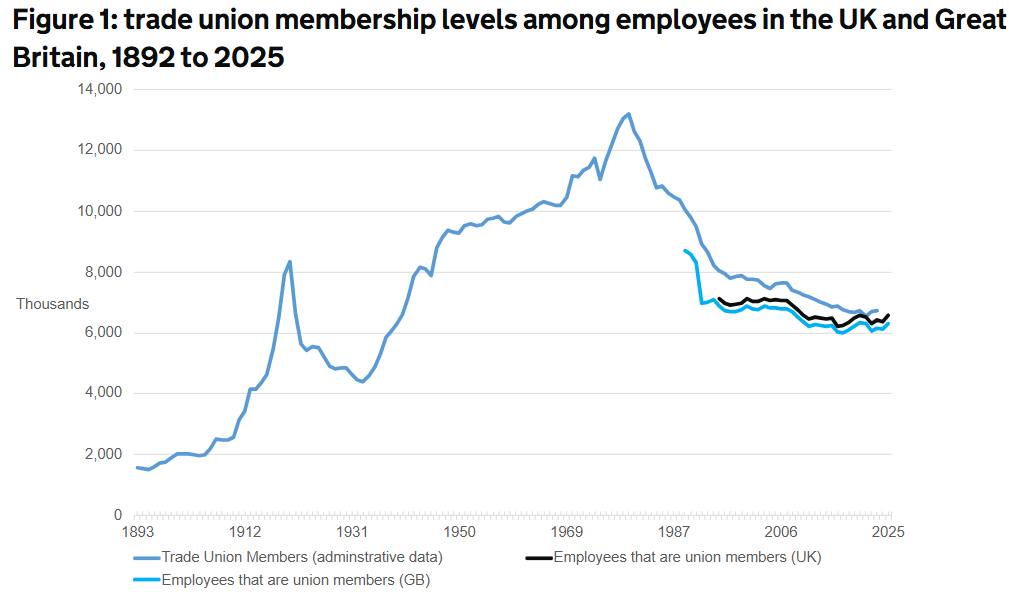
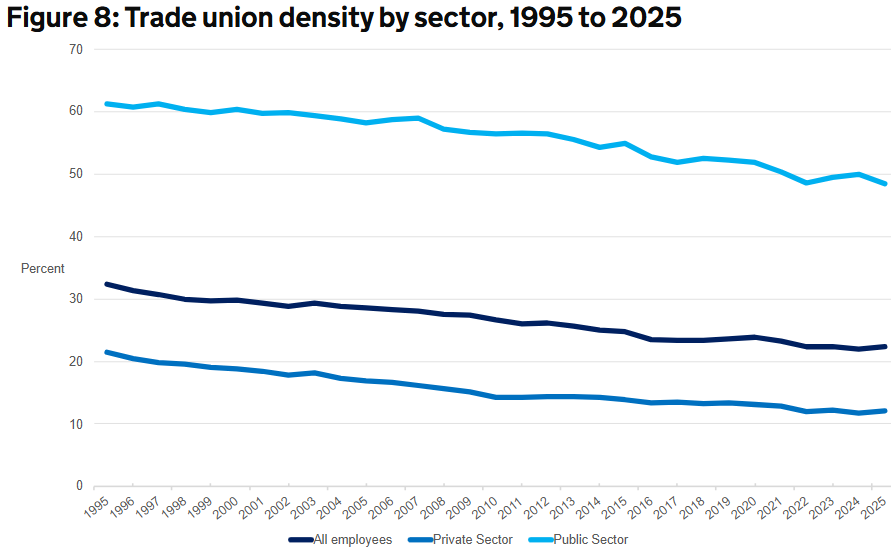
The trouble is that trade union membership in the UK is the lowest it has been in almost a century. The decline is proportionally largest in the private sector.
Source: Trade union membership, UK, 1995 to 2025: statistical bulletin
Source: Trade union membership, UK, 1995 to 2025: statistical bulletin
This is a product of many factors, including structural changes to the economy, though an aggressively anti-union stance by Margaret Thatcher’s government over the 1980s explains the steepest decline in the above graph.
The UK’s Employment Rights Act 2025 included a number of measures designed to make it easier for trade unions to recruit members, such as requiring employers to share a government-approved message with workers setting out their right to join a union. These are beneficial, but also feel like a drop in the bucket considering the steep decline in union membership over the past four decades.
With respect to inequality, this is probably the most relevant of all the interventions that have been mentioned so far. Yet restoring private sector workers to anything close to historical levels of union representation will be a potentially decades-long process. Nearer-term solutions are needed.
Summary of likely effects of solutions
Intervention | Likely effects on accountability | Likely effects on inequality |
|---|---|---|
Extending (long-term) shareholder rights | Partial improvement | None |
Public benefit corporations | None | None |
Minimum wages and individual employee rights | None | Partial improvement |
Encouraging trade union membership | Partial improvement over long-term | Improvement over long-term |
Footnotes
- For more on this, I recommend Benjamin Braun’s 2022 paper Exit, Control, and Politics: Structural Power and Corporate Governance under Asset Manager Capitalism. ↩
- 50% of the FTSE 100 are accredited living wage employers, and according to ShareAction, “Investor engagement has played a key role in reaching this milestone.” It is unclear whether this is the case; a 2024 CIPD survey found a similar proportion (45%) of companies with 250+ employees who responded were also accredited, and “External pressures (e.g. investors, media, client/customers, etc)” was the second lowest reason given for accreditation, by 10% of respondents. Yet even if investor pressure has been instrumental at raising the baseline for low-wage employees - a positive outcome - they may still not be well-placed to advocate for fairer pay throughout the wage distribution. ↩
- Of course, this was classified by many as a win, a rebellion, a revolt. From a campaigning point of view ShareAction should indeed be credited for moving this issue up investors’ agenda. But claiming victory is again revealing of our low expectations when it comes to stewardship. Reminds me of this poem. ↩
- And as things stand, employees’ bargaining power looks set to weaken further with the threat of AI-induced unemployment hanging over them. ↩