Giving employees (significantly) more power
Investors have tended to be sceptical of empowered employees, and in particular the idea of workers on boards. It goes against dominant ideas of what “good governance” should look like. The thinking goes that employees have their own set of interests that are not always going to be aligned with shareholders’; give them enough power to influence corporate decision-making, and the result will be sub-optimal outcomes. Even those investors who have demonstrated support for the idea of workers on boards have been clear that such workers must be a small minority of board seats; worker directors’ role is to better inform a shareholder-governed board.
So I will be clear up front that what I am proposing goes beyond that, to (eventually) making employees a countervailing source of power in firm governance and decision-making. There are a variety of forms this could take and I will not recommend any in particular, beyond saying that a wide range of options should be on the table, including working towards a model where a sizable number of directors are employee-nominated.
I understand that for some investor readers, you may now be shaking your head dismissively. “Sure,” you think, “investor stewardship has its problems, and something more than a disclosure-based regime is necessary. But firm-level decision-making should be a combination of management knowledge and shareholder input.” Please, suspend your disbelief, and read with as open a mind as you can!
Powdrill and The Predistribution Initiative’s recent paper helpfully outlines why investors need to reconsider their opposition to employee governance, especially in light of how corporate ownership and practices have changed in recent decades:
Workers have a single-firm focus, and so are more incentivised to ensure the financial success of any given company compared with investors who are highly diversified
Shareholders’ governance rights are partially based on the notion that shareholders are the last to be paid after all other stakeholder obligations have been met. In reality, companies often prioritise retaining a steady dividend and returning cash to shareholders over delivering wage increases or avoiding redundancies.
Workers have an informational advantage; they are able to evaluate whether management claims match the reality on the ground.
Workers face higher barriers to exit. Governance theory would suggest that “voice” rights should be granted for the parties most likely to remain involved with the business; instead in the UK it’s reserved for the party most likely to leave.
This last point is particularly important from an accountability point of view. Even when an investor does everything right - adopts a long-term perspective, enters into informed engagement with investee companies - they might rationally decide to exit a company rather than seek to turn it around. This is for example what occurred at Carillion - leaving workers and other shareholders holding the bag.
What is the evidence for how a more empowered employee base might affect outcomes?
The answer is “it depends”. Workers on boards is one of the most studied phenomena; a recent literature review found “codetermination has zero or very small positive effects on worker and firm outcomes”. More studies with similar findings are summarised in the footnotes.26 The limitation of virtually all of these studies is that workers on boards are usually one feature of a policy architecture and economic environment which are already more favourable to workers than the UK. The literature review thus concluded: “Several important labor market institutions—sectoral collective bargaining, widespread union representation, and extensive regulation—may already capture most of the low-hanging fruit when it comes to affecting worker outcomes, leaving little room for German and Nordic codetermination to make an impact. If this explanation is correct, then codetermination may have larger impacts (either positive or negative) if implemented in contexts like the United States, where these institutions are less powerful.”
Regarding workers’ councils, most of the evidence comes from Germany. One review: “Most empirical studies find a positive effect of works councils on establishment productivity in Germany . . . with the majority of estimates between 12 and 25 percent.” On wages, “Works council firms pay higher wages than firms without a works council . . . between 5 per cent and 22.5 percent”. Some studies find that these benefits are dependent on the presence of collective bargaining. Perhaps most interestingly, regarding profitability, it notes that studies which find a negative impact on profitability generally rely on managers’ subjective evaluations, while those relying on objective measurements find a positive impact.27
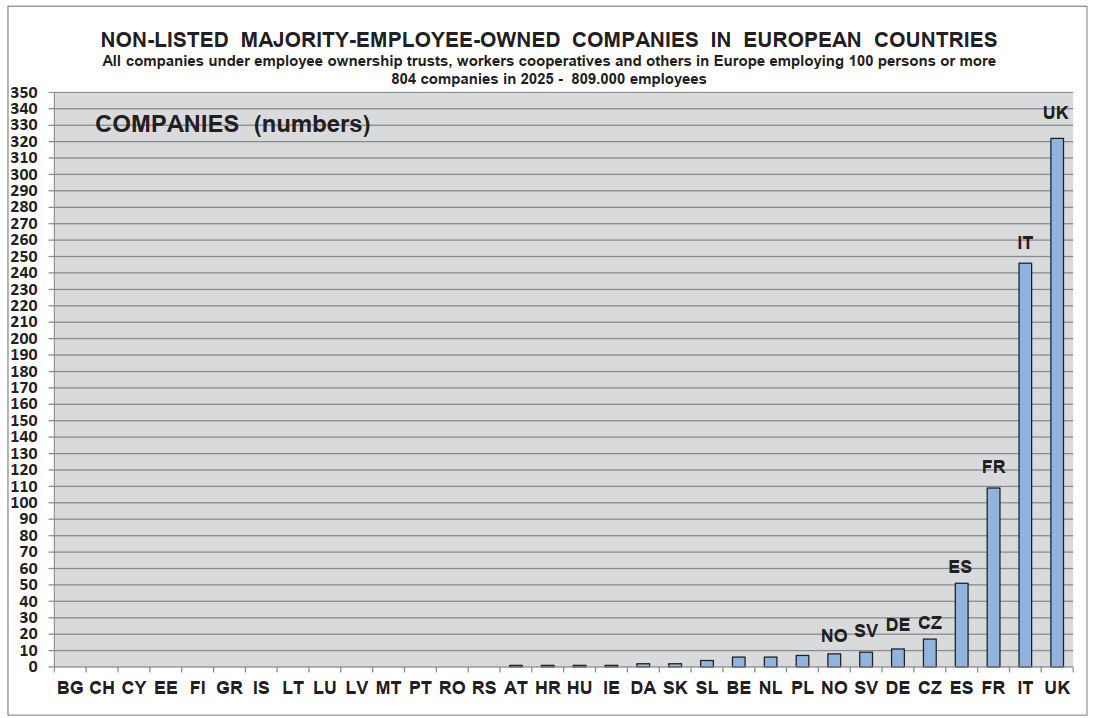
Employee ownership is an area that has seen massive success in the UK over the past decade. The number of businesses converting to majority employee ownership has been doubling roughly every 1.7 years (though this growth has declined significantly since tax changes last year), and the UK now has the most mid-sized companies which are majority employee-owned in Europe.
Source: EFES, 2025 Annual economic survey of employee share ownership in European countries (Page 120)
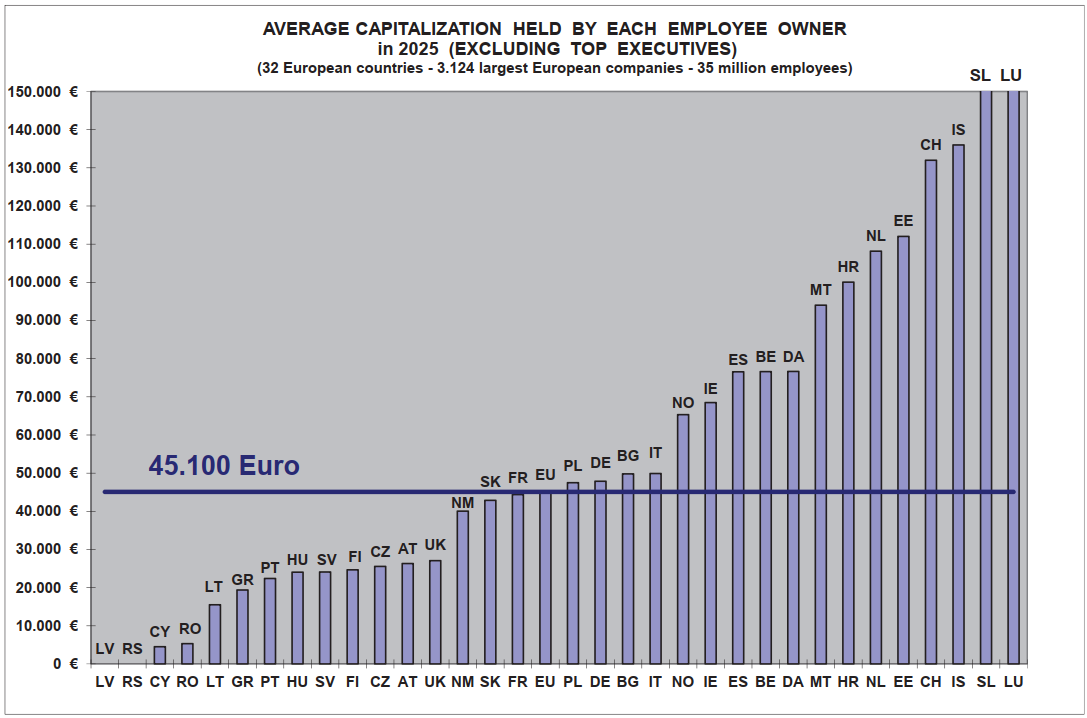
Yet this story gets flipped when applied to publicly listed companies. The proportion of employees with some share ownership - 24.1% - is higher than the European average, surpassed only by France.28 Yet the value of the average employee’s shareholding is actually substantially lower than the European average - about €27,100 per employee, compared with Europe’s €45,100.
Source: EFES, 2025 Annual economic survey of employee share ownership in European countries (Page 82)
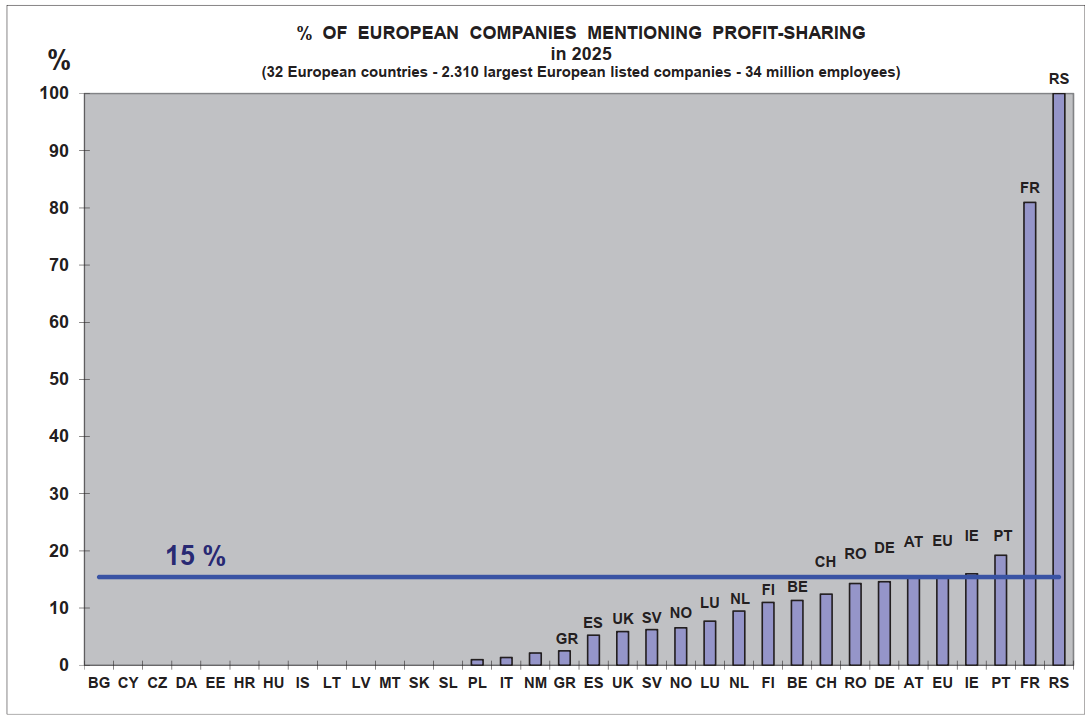
In many of those other countries where employees hold less value in shares, public companies instead use profit-sharing schemes; however here too the UK is substantially below the average.
Source: EFES, 2025 Annual economic survey of employee share ownership in European countries (Page 110)
All of this suggests that workers stand to gain little in the event that the UK government’s growth agenda manages to deliver greater profitability for UK plc. It doesn’t have to be this way; the Ownership Works initiative has shown that even cold-blooded private equity firms see that sharing gains with employees can be a win-win for everyone.29 Employee ownership is starting to gather support among mainstream investors; now is the time to translate that into action.30
There are also more niche interventions to consider as part of an employee empowerment package. For example, under Czech, Hungarian and Polish legislation, minority worker directors are able to submit a special report to the AGM in case of serious dissent; this is much more useful than the current lengthy strategic reports prepared by management on how stakeholders have been considered. In the US, billionaire Mark Cuban has proposed that employees and CEOs should earn the same percentage of their pay in stock. Bernie Sanders has proposed a tax-based approach, where companies with CEO-to-worker pay ratios over 50x face progressive tax burdens.
What precisely the right mix of these tools looks like in a UK context is an open question. The above studies can only inform us so far; the UK has different features from many of those countries such as a unitary board structure31, a more adversarial relationship between labour and management, weak worker power, fragmented share ownership, higher inequality. These aren’t reasons against action; many of them are products of what we’re seeking to solve.
A 2020 paper, A flexible model for efficient employee participation in UK companies, makes a compelling case for a gradual model whereby employee advisory panels are introduced, with a non-executive director liaison, which over time builds towards increasing employees’ ownership stake in the companies they work for and their representation on the boards of directors.32 Something like this could provide a starting point for discussions between investors, companies, labour groups and government bodies to advance a workable plan to increase labour power over the short- and medium-term.
What about the impact on other ESG issues?
Even responsible investors who might accept the need for a rebalancing of a share of corporate income, and power, towards workers, might fear that it will come at the cost of progress on other sustainability issues. That workers will take a narrow view of their own and their firms’ interests. I do not believe that will be the case; in fact, I believe workers will often have an advantage when it comes to addressing systemic issues.
As was seen in the Sainsbury’s living wage vote - and more famously with climate change - investor stewardship often struggles in the face of first-mover and collective action problems. But despite a lack of formal governance power, employees have often shown themselves capable of navigating these challenges and achieving breakthroughs. Witness the well-known concerns about AI safety, where leading AI companies are concerned about the safety of their own products but none feel capable of slowing down lest a more irresponsible company takes the lead. An open letter from over 1,300 employees of these companies called for a government intervention to “pace the frontier” of AI development; this plus high-profile resignations led to Anthropic CEO Dario Amodei writing a blog post titled “We must pace the frontier” also calling for government intervention, which was then endorsed by the CEOs of other major US AI companies (the US government has refused to act). This is by no means an isolated example.33
So, far from workers posing a barrier to progress on systemic issues, I think they may be our best chance. So much of the investment chain often seems paralysed by competitive pressures and concerns about fiduciary duty that there’s no space for human moral judgement. I find myself reading paper after paper noting that 1.5 degrees of warming may be terrible for the world, but asking: is the business case strong enough? Investors need workers to save them from themselves.
Footnotes
- Other studies: A 2022 paper: While some of the studies still point to the negative consequences of BLWR [board-level worker representation] for the firm’s value, an increasing number of studies point to non-negative effects of BLWR for the employees and the company as a whole. A French study found a positive impact on job quality, with no evidence of adverse effects on firm performance. A Finnish study found “worker voice raised labor productivity. . . no effects on voluntary job separations, and at most small positive effects on other measures of job quality. However, we find evidence for reductions in involuntary separations during the recessionary context.” In Norway there were no significant effects on firm performance; there was a wage premium but the authors claimed this was not caused by representation. ↩
- Another study finds councils induce larger performance effects in adverse economic conditions. Councils let workers check management’s claims about a crisis, so workers accept “legitimate” concessions. ↩
- EFES, 2025 Annual economic survey of employee share ownership in European countries, Page 147. However, this is also the lowest proportion it has been in the UK in 12 years; see Page 19. ↩
- Noting that there’s a fair discussion over whether this should be considered true employee ownership, and the need to weigh this with the private equity industry’s broader impacts. Nonetheless, the initiative has clearly done a great service by helping raise expectations of what a fair deal for employees looks like. ↩
- The investment industry could also support this trend by developing investment products that finance employee ownership conversions. The US has a substantial and growing selection of investment funds in this space; the UK has almost none. ↩
- Though nor should this be exaggerated; there are several markets which incorporate worker representatives on unitary boards. ↩
- The paper points out the interplay between various aspects of the German system and thus why simply transplanting co-determination rules alone could prove counterproductive. Where I depart from the author is on the idea that this could be achieved without regulatory reforms; for the reasons set out above on the impasse over improving worker wages, I do not believe that voluntary action here will be able to overcome first-mover and accountability problems. A just released paper from The Predistribution Initiative also explains some of the limits of a voluntary model. ↩
- Employee activism on ethical grounds has a long history. Several whistleblowers have come forward in recent months with concerns about how their employers have handled AI safety. Last week UK employees at Meta issued a statement condemning the company for interfering with elections in Brazil. Dockworkers have refused to load military material bound for Israel. Senior employees at UK food companies have alerted the public to the climate impacts they are causing. I could go on; other research I’ve done finds 100s of examples. Of course this won’t be the case at every company; it’s unlikely to unleash a renewables revolution at fossil fuel companies, say (though don’t underestimate the degree to which workers at these companies see the need for change either). ↩