Have outcomes improved?
Let’s look at three areas where disclosures have been introduced and outcomes can be easily quantified: executive pay, pay ratios, and the gender pay gap (which is not on the chopping block under the current consultation, but is subject to a similar theory of change2 and touches on similar issues of inequality and fairness).
Executive Pay
Below is the evolution of average FTSE 100 CEO pay over the past 50 years or so, adjusted for inflation, up to 2022.3 The High Pay Centre’s 2026 report tracks more recent pay, which shows pay is now close to its 2016 peak once more.4
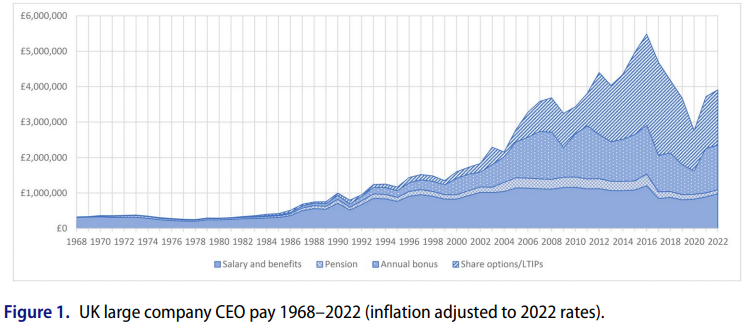
Source: Pepper (2024), CEO pay in the United Kingdom, 1968-2022
Annual advisory votes took effect from 2003; binding triennial votes on remuneration policy took effect from 2014. The advisory votes seem to have caused an explosion rather than contraction in CEO wages; the binding votes may have contributed to a temporary pullback which has since rebounded (COVID-19 also played a role, likely a larger one).
If investors’ (or policymakers’) intent was to reduce or restrain executive pay via shareholder votes, the policy clearly would have been an abject failure. However, this was never an explicit priority of either group; rather, the stated intention of these votes was to incentivise executives to deliver value for shareholders, and put an end to unmerited high pay awards. In other words, pay-for-performance.
On this front, investors might point to a variety of successes - most executive plans now have short- and long-term incentive plans with a variety of metrics tied to performance targets and clawback provisions. Executives are also subject to minimum shareholding requirements.
I would like to point out two problems with the idea that Say on Pay has delivered pay-for-performance.5
The first is what all of this “incentivisation” has cost. The explosion in CEO pay quantum is directly attributable to Say on Pay. Incentive plans and share grants were on top of rather than replacing existing compensation. CEOs demanded higher gross pay to account for the added risk, complexity and delayed payouts. Public disclosure of pay plans led to CEO pay being benchmarked against peers, leading to a neverending cycle of the below median CEOs’ pay being increased to catch up with their higher paid peers (whose pay would then fall below the median).
These increases vastly outpace the performance these executives have delivered (see chart below). Thus it feels inaccurate, or missing the forest for the trees, to claim that what Say on Pay has achieved is “pay-for-performance” - rather, they’ve increased pay’s sensitivity to performance, which isn’t quite the same thing. The worst-performing CEOs today receive a lot more than the top performers in 2004. If you were pissed off in 2004 about executives receiving awards beyond what their performance justified, you should be even angrier today.
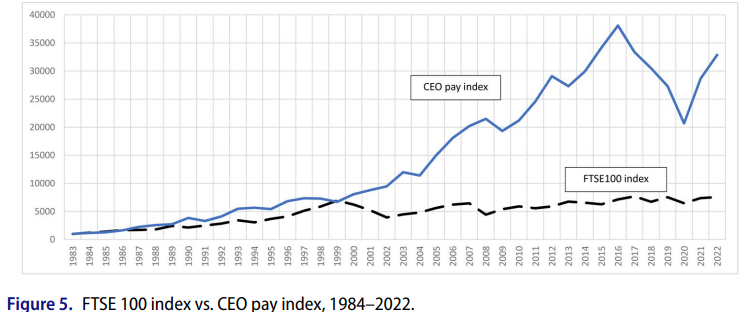
Source: Pepper (2024), CEO pay in the United Kingdom, 1968-2022
Then there’s the indirect costs. These votes have swelled the ranks and demanded the resources of an industry of compensation consultants, proxy advisors and investors’ governance staff. The rising quantum has also further exacerbated inequality, stoked public rage and demotivated employees.
The second problem with this story is that it’s not even clear that all of this was necessary or effective in actually incentivising CEOs. A recent survey by Edmans, Gosling and Jenter found that both investors and boards believe a CEO’s intrinsic motivation to do a good job and their personal reputation are much more important drivers for their efforts than their pay packages. Many of the motivating aspects of modern CEO pay packages (such as getting paid more than peers) would only be missed because of Say on Pay in the first place. And the FTSE 100 index has not seen dramatic performance improvements since Say on Pay was introduced.
Given the number of metrics and targets a CEO is subject to under these plans at any given moment (from an example chosen at random, I counted at least 23 metrics or targets which the CEO is currently subject to6), it’s hard to say how effective they can be at motivating behaviour. On the other hand, some have also found incentive plans increase risks of illegality and crowd out prosocial behaviour. It is then no wonder that investors like NBIM have called for simpler plans. That, coupled with stronger monitoring by boards and investors, could have achieved superior results without all the headaches and ££££.
Say on Pay has had the most time of the measures discussed here to achieve its stated goals, and shareholders have been granted extensive rights to shape outcomes in their desired direction. The results have not been exemplary.
Pay Ratios
For all of the attention and ink spilled over executive compensation (to which I have reluctantly just added), it can be a bit of a distraction. From a public interest angle, executive compensation is a rough proxy invoked in conversations and commiserations over inequality, and who shares in the benefits of wealth that was collectively created.7 In recognition of that, the UK government introduced a requirement in 2018 for companies to report against the ratio of CEO pay to a company’s median employee (and employees at the 25th and 75th percentiles).
Fortunately, compared with Say on Pay, there is less ambiguity about the goal of ratios: bring them down. While pay ratios dropped substantially in 2020, this was a COVID-19 blip, reversed the following year; ratios stayed largely flat through 2024. Not captured in the below graph is early data from 2025, which suggests ratios are rising and may reach record levels: the median FTSE 100 CEO to lower quartile employee ratio was 127:1; the median employee ratio was 95:1.
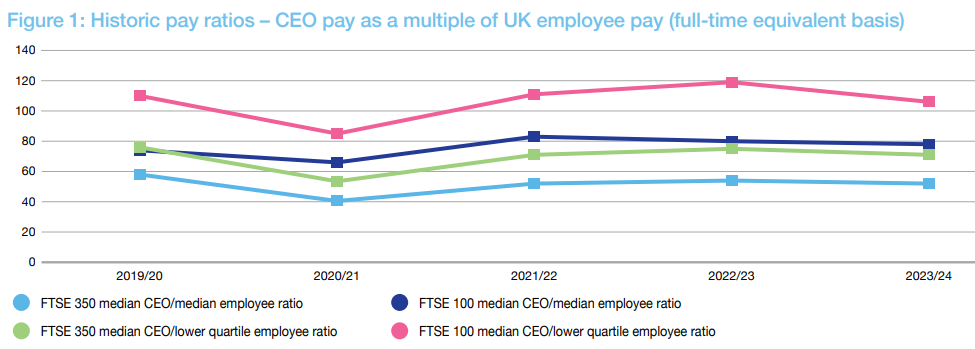
Source: High Pay Centre (2025), Five Years of pay ratio disclosures
Gender Pay Gap
Gender Pay Gap reporting commenced in 2018 for companies with over 250 employees. Again, its stated aim was clear: the gender pay gap was closing too slowly, and the government wanted to accelerate progress.
The evidence here is mixed. Below is ONS tracking of the gender pay gap for the past 30 years.
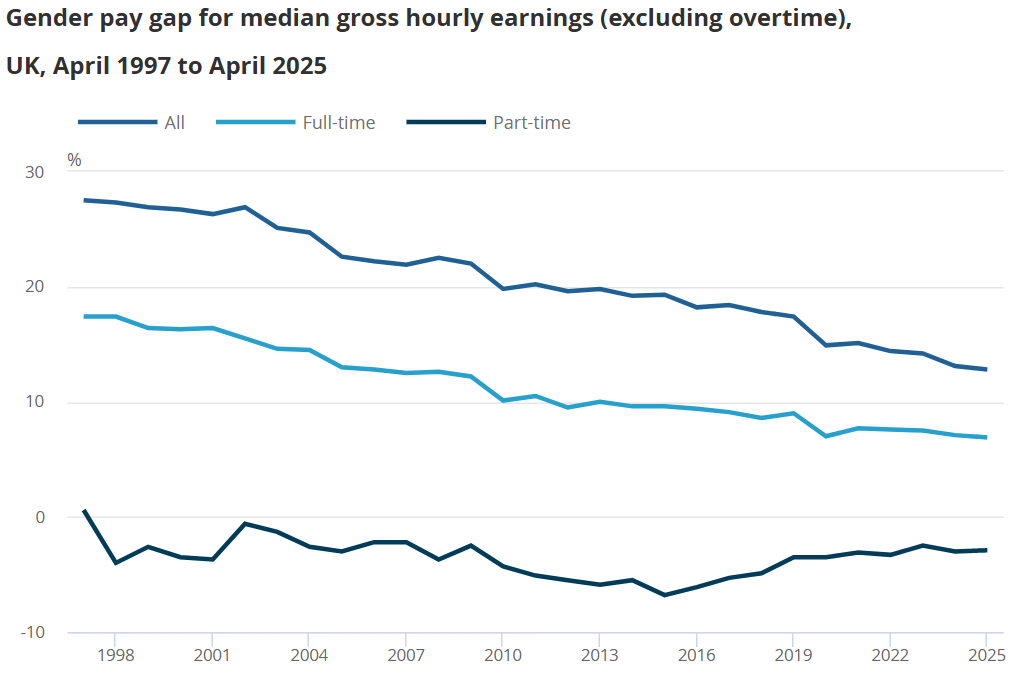
Source: Annual Survey of Hours and Earnings (ASHE) from the Office for National Statistics
There appears to be a substantial drop occurring in 2020, with the gap falling from 17.4% to 14.9%. It could be tempting to ascribe that to the impact of COVID-19 and furloughs, but according to the ONS, “furloughing had a small impact on the gender pay gap, and the majority of the reduction in the gap is because of underlying changes in pay.”8
Attributing this fall to the influence of GPG reporting, though, seems even more unlikely. As you can see from the below chart, companies which were subject to reporting requirements (250+ employees) actually saw less reduction in their pay gap than those who weren’t.
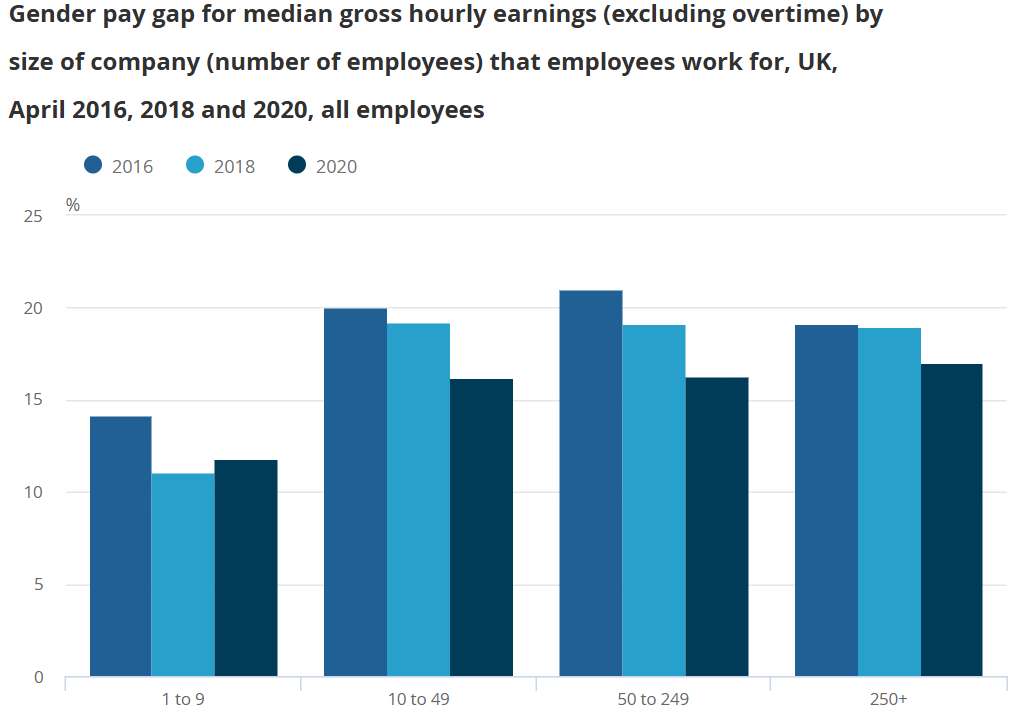
Source: Office for National Statistics – Annual Survey of Hours and Earnings (ASHE)
The study with the most positive evidence of GPG reporting efficacy found that it narrowed the gap at firms just over the 250-employee threshold by 19% in the 2 years after reporting was introduced. This was achieved by reducing men’s pay growth rather than improving women’s pay. Given the size of companies where this effect was observed, the improvement may have been driven by internal forces triggered by revelation of the gap, rather than external pressure.9 Indeed, FTSE 100 companies - which are subject to greater public scrutiny as well as investor stewardship - have a larger GPG than the UK’s average (15% vs 12.8% in 2025).
* * *
Perhaps more worrying than the fact that these approaches have not delivered against their stated goals, is a failure to learn from their shortcomings. The unconvincing evidence on the impact of gender pay gap reporting has not deterred the creation in September of a new campaign for ethnic pay gap reporting. And then there was the campaign to introduce annual “Say on Climate” votes, without seemingly any sense of irony of the failures of the Say on Pay votes the concept was based upon.10 This habit of defending or even extending measures which have failed to deliver results or accountability is endemic.
Of course, a simple analysis such as this does not account for many nuances - for example, could outcomes without these disclosures have been even worse? More importantly, are these even appropriate measures against which to measure progress? They all gesture at the underlying systemic issue of inequality, though they are mostly crude proxies.11
To varying degrees for each of these measures, part of the reason for the poor outcomes has been a weak or unclear theory of change underpinning them. Successive governments have focused on the easy work of surfacing inequalities through disclosure, rather than considering what are the drivers and who has the incentives and power to change them.12
Another lesson from this though is that when it comes to tackling the challenges of inequality and corporate accountability, investors may not be a very reliable partner.
Footnotes
- This theory of change is that encouraging companies to disclose this information will make it pertinent and will enable stakeholders including investors to scrutinise it. That scrutiny will result in the underlying practices improving. ↩
- Data prior to the creation of the FTSE 100 in 1984 covers comparable groups. ↩
- The High Pay Centre report does not adjust for inflation, so the report states that CEO pay is at record levels for the past 4 years. ↩
- A third problem is that many metrics are gameable, and/or pay out substantial amounts for mediocre performance. But I want to focus on the two more fundamental problems. ↩
- At the time of writing, Smiths Group plc was the most recent FTSE 100 company to publish their annual report. CEO Roland Carter’s annual bonus plan contains 7 named metrics, one of which is “strategic objectives”. The named objectives are “energy reduction targets, innovation priorities and [a] strategic separation programme”; let’s conservatively count this as 3 metrics, meaning the annual bonus is rewarding performance against 9 measures. There is a long-term incentive plan granted in 2026 which contains 4 performance metrics. The 2024 and 2025 LTIP plans are also still active, containing 5 performance metrics. Of course, several of the metrics across plans are the same, but they cover different performance periods. Does anyone really think the CEO is weighing these 23 factors when he makes decisions (on top of other factors outside of his pay plan)? Isn’t the whole point of paying a CEO well that they have superior judgment and instincts, and so trying to minutely proscribe decision-making in this way is counterproductive? ↩
- Though that being said, I was taken aback by this High Pay Centre finding: “Capping the pay of CEOs of the 112 UK companies in the sample that are not accredited living wage employers at 10 times that of their median employee would have saved about £267m on CEO pay in 2023/24. This would be enough to raise the pay of nearly 87,000 minimum wage workers to the level of the real living wage.” ↩
- There appears to be disagreement about the extent to which the lasting fall in the GPG visible in the chart is accurate. There is a discontinuity in the ONS data in 2021. A 2026 study commissioned by the government concluded: “We find little evidence of a reduction of the GPG in recent years. Over the last 10 years the GPG has remained broadly stable. It declined slightly between 2009 and 2016 and then levelled off thereafter.” Nonetheless, it claimed “Mandatory GPG reporting . . . promotes transparency and accountability.” ↩
- The authors suggest public scrutiny was a causal mechanism; however that is difficult to square with the weaker progress at public companies subject to much greater scrutiny. The early period of GPG reporting also coincided with the peak of the #MeToo movement, which could have increased attention to GPGs and efforts to close them. ↩
- That said, its failure to catch on is at least partly due to enough investors and other groups updating their thinking on what works. ↩
- For example, higher pay ratios might be desirable if it’s because a company has outsourced fewer functions, extending employment protections and mobility opportunities to a wider range of workers. Larger gender pay gaps could be a product of subtle discrimination within a firm, or it could reflect uneven take up of generous flexible working arrangements by men and women. ↩
- I will leave it to others to opine on which of these disclosures should be retained. Some disclosures obviously play a supporting role in enabling change (indeed, some of this essay would be impossible without them). ↩