Is accountability being delivered?
The Modernising Corporate Reporting consultation proposes allowing virtual-only AGMs, subject to shareholder approval. Investors and related groups have been highly critical of the trend towards online-only AGMs since COVID-19. ShareAction has been one of the most outspoken, claiming it would be a “massive setback for corporate accountability”, and putting out a 13-page policy statement on “Defending and Strengthening the AGM as a forum for corporate accountability”. The word “accountability” appears in the document 18 times.
Yet what accountability is actually being defended here? ShareAction cites evidence that virtual-only AGMs constrain shareholder voice by “1. Ignoring submitted shareholder questions; 2. Preventing shareholders from presenting questions in their own words; 3. Restricting questions only to proposal-related topics; 4. Reporting only pass/fail voting outcomes instead of exact vote tallies.”
These shortcomings may relate to accountability in a hyper-literal sense.13 But the kind of corporate accountability we need in the UK is not the ability to put hard-hitting questions to executives and directors in front of other shareholders (the majority of whom are absent and/or have already cast their votes), and watch directors provide canned PR-prepared responses. The accountability we lack is the ability to drive changes in corporate behaviour in response to well-publicised behaviour which negatively impacts stakeholders and exacerbates systemic risks. In this, physical AGMs have played no discernible role.14
Another irony of the proposal to permit virtual-only AGMs is that companies would need to obtain shareholder approval to have them. What, then, is there to fear? Can shareholders not be relied upon to vote in line with their own long-term interests, and to support accountability?
Well, no. In fact, much of what goes for accountability in a stewardship context is highly counterintuitive. Those who work in the industry are perhaps so used to it that they no longer question it. But taking a step back, it’s unclear why we accept the logic of this system as we find it.
A 20% vote against an AGM proposal is generally considered “significant” and meriting a company response, per the UK Corporate Governance Code. But why should this be? If a public election or referendum saw 60%+ support, it would be considered a landslide. Internationally, there are all sorts of elements that distort shareholder voting tallies: a large shareholding from a founding family in much of Europe, dual-class structures in the US, or uninformed retail investors who might blindly support management. None of these are significant in the UK. Here, shareholder vote outcomes should reflect the preferences of theoretically long-term institutional investors.
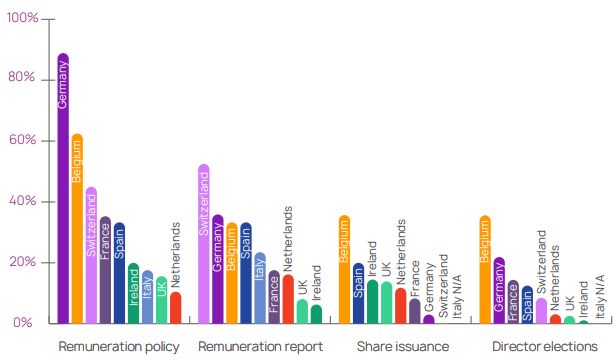
Above: Proportion of 2026 AGM proposals seeing at least 10% opposition. Source: Georgeson, 2026 European AGM Season Review.
Shareholder opposition to AGM proposals in the UK is extremely low. This would suggest a high degree of shareholder satisfaction with outcomes at UK publicly listed companies, despite the findings set out in the preceding section.15 Director reelection defeats are almost unheard of.16 Even major scandals such as BP’s Deepwater Horizon oil spill or the awful factories supplying Boohoo in Leicester did not see any directors lose their jobs.17
“Against” votes are too often treated as a precious, scarce resource that can only be used when all other efforts have failed, rather than an honest verdict on the substance of a proposal. Investors look for all sorts of reasons to justify supporting inadequate proposals (or opposing desirable shareholder proposals): progress is insufficient but has exhibited a positive direction of travel; it’s better to vote against advisory proposals for a year or two rather than going straight for a director; let’s engage first so management understands our view.18 Escalation is step-by-step, it unfolds over multiple years, and skipping steps is discouraged. Such an approach betrays a lack of urgency, despite the high-stakes rhetoric the responsible investment industry is fond of deploying. It stems from a culture of timidity in responsible investment, and a lack of accountability throughout an investment chain which manages other people’s money.
Corporate governance theory tells us that voting outcomes aren’t the only way of ensuring corporate accountability, however. According to the theory of the market for corporate control, boards and management are also held accountable by the potential for activist investors intervening if a company seems undervalued or shareholders are dissatisfied. These activists may shake up the board and/or use their influence to realign the company with a vision for value creation that investors share.19
The trouble here is that this approach only really works for changes that can deliver near-term share price gains at an individual company. Activists’ asks normally revolve around cutting R&D budgets, spinning off assets, and returning more money to shareholders. Their playbook is a decidedly poor match for systemic issues like inequality which require long-term action across entire sectors.20 Thus the most proven avenue for accountability by investors is actually tilted against long-term sustainable outcomes.
To summarise the state of corporate accountability to investors today, then: some of the main tools relied upon today are either ineffective (in-person AGMs), underutilised (voting), or skewed against a long-term perspective (activist investors).
For an illustration of all of these dynamics at once, take a look at developments at BP over the last two years. Elliott Investment Management - which is a highly (short-term) outcomes-driven activist investor - achieved many of its key goals with a minority stake, which included accelerating BP’s abandonment of its sustainability commitments. Responsible investors’ stewardship was by contrast much more process-driven, and as Tom Powdrill points out in his write-up, ended up being largely orthogonal to the ultimate outcome.21 At the 2026 AGM, BP’s chair pursued a number of “anti-accountability” measures - including virtual-only AGMs and refusing to put a shareholder proposal to a vote - and yet while problematic individual proposals were voted down, the chair’s apparent disconnect from shareholder preferences did not even generate a significant vote against his reappointment. It fell to the board to police itself, ousting its chair due to governance concerns just weeks later.
Footnotes
- Merriam-Webster defines accountability as “an obligation or willingness to accept responsibility or to account for one's actions”. Nuanced approaches to accountability differ between ‘’soft’ accountability (transparency and answerability) and ‘hard’ accountability (facing consequences, sanctions, remediation). ↩
- By the way, I’m not seeking to take a pot-shot at ShareAction here, who do leading work on accountability throughout the investment chain, and given their tactics and broader goals it’s understandable why they would defend physical AGMs. They’ve also previously proposed more significant reforms to AGMs that go unmentioned in that policy paper but which could actually make in-person AGMs worth defending, if they were implemented. More on that later. ↩
- Noting that on occasion companies will withdraw proposals rather than risk their defeat by a shareholder vote, slightly depressing these numbers. ↩
- According to Georgeson data from the past 5 AGMs, only 2 companies have seen a director receive less than 50% of the vote, and both occasions (Petropavlovsk in 2021 and EWIT in 2026) were caused by a dispute between management and a large blockholder shareholder seeking control, not opposition from institutional investors. ↩
- BP’s CEO did step down, though that does not seem attributable to shareholder pressure in particular. ↩
- I’m aware that some investors fear damaging their relationship with management if they vote against proposals. Yet this becomes a self-fulfilling prophecy which traps them. Engagement with companies which is collaborative and constructive (rather than adversarial) is perfectly compatible with an approach to voting which focuses on substance and accountability. ↩
- See, for example, Gilson and Gordon (2013), The Agency Costs of Agency Capitalism: Activist Investors and the Revaluation of Governance Rights. ↩
- I hardly need to remind readers of the lack of outcomes delivered by the only climate-focused proxy battle to date. ↩
- And isn’t this true of so much of stewardship - it ends up being a showy distraction? It reminds me of a common criticism of the sport of quidditch in Harry Potter, which here in the obscurity of the footnotes I’m only too delighted to explain. In quidditch, there are three chasers who can score 10 points every time they throw a ball through a hoop, guarded by a keeper. The majority of the game’s action revolves around this. Yet all the while, there is one player on each team - a seeker - who is looking for a separate tiny ball called the snitch. Catching the snitch earns the seeker’s team 150 points, and ends the game. The criticism made of quidditch is that the presence of the snitch mostly renders the rest of the game irrelevant - the team who catches the snitch will almost always win. This is how it can feel watching stewardship - it’s the flashier side of the game, focusing the crowd’s attention on bold public statements and vote tallies. Yet it too often doesn’t affect the outcome of the match. ↩